2026 Best Marble Slab Types for Global Buyers?

Choosing the right Marble Slab in 2026 requires more than comparing color, price, and showroom photographs. Global buyers must assess geology, processing quality, supply stability, and installation requirements. A beautiful white slab can still fail if its fissures, water absorption, or thickness are poorly evaluated.

Recent market studies provide useful direction. Grand View Research’s natural stone market analysis identifies continued demand from residential interiors, hospitality projects, and premium commercial spaces. Mordor Intelligence’s marble market research also highlights Asia-Pacific as a major consumption and production region, supported by construction growth and expanding interior design investment. However, these reports measure markets differently. Their forecasts should guide decisions, not replace technical inspection.

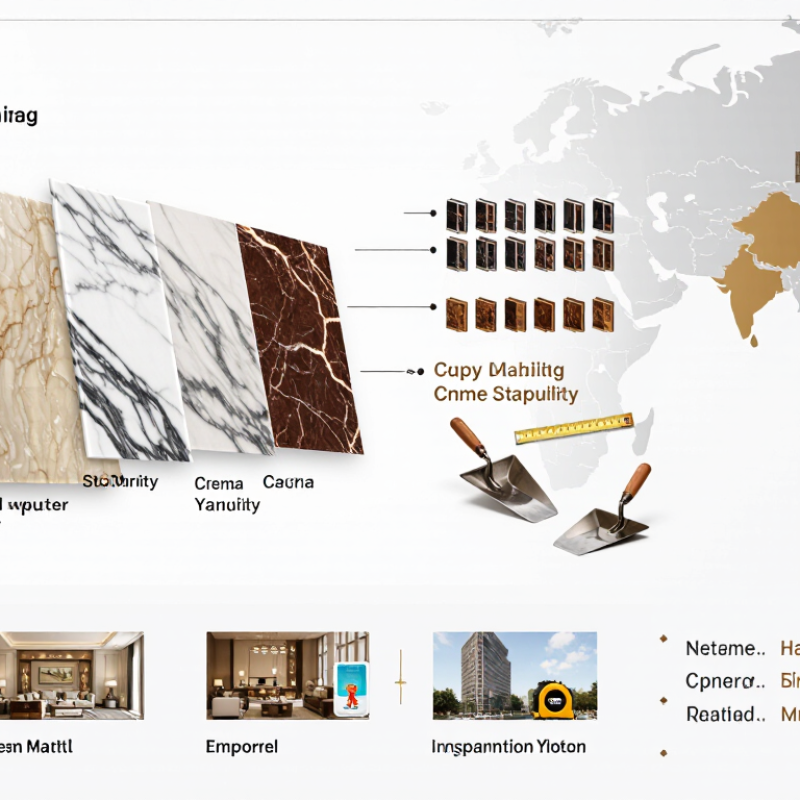
For 2026 purchasing plans, buyers may compare Carrara, Calacatta, Statuario, Crema Marfil, and darker varieties such as Emperador. Each option creates a different visual and maintenance experience. Carrara usually offers softer gray veining and broader availability. Calacatta often provides stronger contrast and higher price pressure. Statuario can look dramatic under warm lighting, but matching bookmatched slabs may reduce usable yield. That detail matters.

Look closely.

The Natural Stone Institute’s technical resources emphasize proper fabrication, sealing, handling, and installation practices. Buyers should request quarry origin, batch photographs, thickness tolerance, resin treatment details, test results, and replacement policies. Independent inspection remains valuable, especially for large hospitality or residential orders. I have seen buyers focus heavily on veining, then discover shade differences between samples and full slabs. That mistake is avoidable, though not always completely. A reliable supplier should explain those risks clearly and document every stage before shipment.
2026 Best Marble Slab Types for Global Buyers?

Marble Slab Taxonomy: Calcite, Dolomite, Breccia, and Serpentine Types

2026 Best Marble Slab Types for Global Buyers

Marble Slab Taxonomy: Calcite, Dolomite, Breccia, and Serpentine Types

Marble selection starts with mineral identity, not color alone. Calcite marble contains mainly calcium carbonate and often shows clear veining. It can react quickly with acidic cleaners, leaving dull marks. Dolomite marble contains magnesium-rich carbonate minerals. It usually offers better scratch resistance, but it is not stain-proof. A small lemon test can reveal sensitivity, though professional testing remains safer and more reliable.

Breccia marble is recognized by angular stone fragments joined within a contrasting matrix. Each slab can look dramatic, but pattern continuity may be difficult across a large island. Serpentine types often display green, olive, or black tones with soft, flowing movement. Their mineral structure varies widely. Some slabs perform well indoors, while others may show scratching, moisture sensitivity, or surface change.

Ask suppliers for quarry origin, technical data, water absorption, flexural strength, and recent batch photographs. Request an acid-resistance review for kitchen applications. Inspect the polished surface under direct light. Tiny pits are not always defects, but uncontrolled repairs deserve questions. I have found that “premium” appearance can hide practical weaknesses. Global buyers should also compare crate protection, slab thickness tolerance, and climate-related shipping risks before approving production. The best type depends on use, maintenance habits, and honest testing.

Performance Benchmarks: Mohs 3–5 Hardness and ASTM C503 Testing

2026 Best Marble Slab Types for Global Buyers?

Marble slabs commonly measure Mohs 3–5, so scratch resistance varies considerably. Calcitic marble often sits near Mohs 3–4, while denser dolomitic varieties may approach 4–5. Hardness is only one filter. ASTM C503/C503M evaluates dimension marble through density, absorption, compressive strength, flexural strength, and abrasion-related performance. Its reference requirements commonly include density near 2,590 kg/m³ and compressive strength near 52 MPa, depending on the marble group and edition. Buyers should verify the current standard directly.

The Natural Stone Institute’s Dimension Stone Design Manual stresses matching stone selection with exposure, finish, and installation conditions. A polished slab may look excellent under showroom lighting, yet etch beside a kitchen sink. Laboratory results also cannot represent every quarry block. The imperfect point is important: Mohs testing is a scratch-scale comparison, not a complete durability score. Request petrographic identification, water-absorption results, flexural data, and batch-specific samples. USGS Minerals Yearbook reporting also groups much stone data broadly, so marble-only comparisons require careful interpretation.

Tips: Test the actual lot. Ask for ASTM C503/C503M reports, specimen dimensions, test dates, and conditioning methods. For exterior projects, add freeze-thaw and slip evaluations. Keep a spare sample near acidic cleaners for seven days. The result may be less attractive, but more honest.

2026 Best Marble Slab Types for Global Buyers

Performance Benchmark: Indicative Mohs hardness ranges of 3–5, with ASTM C503/C503M used as the relevant dimension-stone specification framework.

Mohs hardness varies with mineral composition, grain structure, weathering and quarry location. ASTM C503/C503M does not define a Mohs hardness requirement; compliance should be verified through the applicable ASTM physical-property tests and an independent laboratory report.

Slab Formats and Thickness: Comparing 18 mm, 20 mm, and 30 mm Options

Global marble buyers are comparing more than color in 2026. Slab thickness affects weight, fabrication, shipping, and installation risk. Grand View Research’s 2024 natural stone market report estimated continued market growth through 2030, supported by residential renovation and commercial construction. That demand makes format planning important.

An 18 mm slab reduces weight and freight pressure. It suits wall panels, vanity tops, and smaller countertops with proper support. However, thin marble can show weakness around sink cutouts and long overhangs. A 20 mm slab offers a practical middle ground. Fabricators often find it easier to transport and finish than thicker material. It also provides a cleaner edge without excessive mass. The 30 mm option creates a stronger visual profile for kitchen islands, hospitality counters, and deep waterfall edges. It weighs much more. Cabinet capacity, lifting equipment, and site access must be checked before purchase. USGS Mineral Commodity Summaries reports continue to track dimension-stone production and trade, but reported values vary by country and stone category.

Tips: Request the measured slab thickness, not only the catalogue size. Confirm flatness, resin treatment, vein direction, and allowable overhangs. A 30 mm slab is not automatically safer. Support design still matters. I have seen buyers focus on thickness while ignoring a narrow stairway or weak cabinet frame. That mistake becomes expensive. Regional standards and fabricator guidance should decide the final specification.

2026 Best Marble Slab Types for Global Buyers? - Slab Formats and Thickness: Comparing 18 mm, 20 mm, and 30 mm Options

Comparison Dimension 18 mm Marble Slab 20 mm Marble Slab 30 mm Marble Slab Buyer Guidance
Typical applications Wall cladding, bathroom walls, furniture panels, low-load decorative work Vanity tops, wall panels, residential countertops with suitable support Kitchen countertops, islands, stair treads, heavy-use commercial interiors Choose according to support conditions, edge exposure, and expected impact.
Common nominal slab formats Approximately 2400–3000 × 1200–1600 mm Approximately 2400–3200 × 1200–1700 mm Approximately 2400–3200 × 1200–1700 mm Actual dimensions depend on the quarry block, cutting plan, and local market standards.
Reference slab size used for weight comparison 3000 × 1600 × 18 mm 3000 × 1600 × 20 mm 3000 × 1600 × 30 mm Weight estimates use a marble density of approximately 2,700 kg/m³.
Estimated weight per reference slab Approximately 233 kg Approximately 259 kg Approximately 389 kg Confirm the exact weight before selecting crates, lifting equipment, and container loading plans.
Relative material consumption Baseline: 100% Approximately 11% more than 18 mm Approximately 67% more than 18 mm Thickness affects stone yield, freight weight, handling, and total project cost.
Edge profile flexibility Best for thin, eased, pencil, or laminated edge appearances Suitable for eased, bevelled, and selected laminated edges Best for substantial eased, bevelled, ogee, and waterfall-style edges Thicker slabs provide more solid edge material and reduce the need for a built-up edge.
Resistance to bending during handling Lower; requires careful vertical transport and closer support Moderate; widely used where adequate support is provided Higher, but still vulnerable to impact and poorly supported spans Marble remains a brittle natural stone at every thickness.
Cabinet and substrate requirements Continuous or closely spaced support is generally advisable Requires properly levelled cabinets and support near cut-outs Requires strong, level cabinets and reinforcement around openings and overhangs Final support design should follow local fabrication and installation requirements.
Suitability for long overhangs Generally unsuitable without engineered reinforcement Limited; support brackets or reinforcement may be required More suitable, but span limits still require professional review Do not approve overhangs based on thickness alone.
Cut-out and transportation risk Higher risk around sinks, cooktops, corners, and narrow sections Moderate risk when corners are rounded and support is adequate Lower relative risk, although cut-outs can still create weak points Use rounded internal corners, avoid sharp re-entrant corners, and protect edges during transit.
Freight and handling impact Lowest weight and usually the easiest to handle Moderate weight and handling demand Highest weight; may require stronger crates and mechanical lifting Check container payload, crate dimensions, forklift capacity, and unloading access.
Relative project cost tendency Usually the lowest stone-volume cost, but may need added support Balanced option for many residential projects Usually higher material, fabrication, and freight cost Compare total installed cost rather than slab price alone.
Recommended buyer profile Projects prioritising light weight, wall use, and budget control General residential buyers seeking a practical balance Projects prioritising robust visual mass, edge detail, and heavy-use performance For most countertop projects, 20 mm or 30 mm is more appropriate than 18 mm.

Notes: Dimensions, thickness tolerances, available formats, and suitable applications vary by quarry, fabricator, destination market, and project specification. Marble density commonly ranges around 2,600–2,800 kg/m³; the reference weights above use 2,700 kg/m³ and exclude crates, pallets, cut-outs, moisture, and packaging.

Global Suitability: Matching Marble Absorption and Finish to Climate

For global buyers, marble slab selection should begin with climate, not color. The World Meteorological Organization reported that 2023 was the warmest year recorded, increasing concern about heat, rainfall, and rapid weather changes. These conditions affect outdoor cladding, countertops, and ventilated façades differently.

Absorption is a practical starting point. ASTM C97 testing expresses water absorption as a percentage by mass. Dense marble may record below 0.5%, while more porous varieties can exceed 1%, according to ranges discussed in the Natural Stone Institute’s Dimension Stone Design Manual. Lower absorption generally reduces staining and moisture movement. It does not make marble maintenance-free. Coastal air, polluted rain, and repeated wetting still matter.

Finish changes performance underfoot. Honed surfaces usually provide more visual consistency after minor scratches, while polished finishes can become slippery when wet. In freeze-thaw regions, buyers should request ASTM C666 or equivalent durability evidence, especially for exterior slabs. Tropical climates need sealed edges and careful drainage. Dry, dusty regions may expose surface marks more quickly. A glossy finish may look impressive in a showroom, but its field behavior can disappoint. That lesson deserves more attention. Evaluate absorption, slip resistance, thermal movement, and maintenance requirements together before approving a full shipment.

Buyer Framework: Evaluating ASTM Compliance, Yield, Pricing, and Supply Risk

For global marble buyers, ASTM compliance should be checked before comparing slab prices. Ask suppliers which ASTM test methods support their claims. Relevant evidence may include water absorption, flexural strength, abrasion, and stain resistance results. Confirm the tested material matches the offered block, finish, and thickness. A polished sample can hide small fissures or resin repairs. Inspect the back, edges, and face under strong, angled light.

Yield matters more than the quoted square-meter price. Measure the usable surface after trimming, vein matching, cutouts, and rejected areas. A slab with dramatic veining may create attractive counters but produce higher waste. Request a cutting layout using your actual project dimensions. Photographs help, but they do not replace physical inspection. Small details matter.

Pricing should include packing, inland transport, ocean freight, insurance, duties, handling, and replacement exposure. Compare landed cost per usable square meter, not headline price. Supply risk also deserves a practical score. Review quarry continuity, block availability, lead times, port congestion, weather disruptions, and backup production capacity. Keep approved reserve slabs when color consistency is critical. No framework is perfect. My own estimates have missed waste when natural fissures appeared after cutting. Build a realistic contingency, and record every assumption in the purchase file.


Close

Raise your Query

Hi! Simply click below and type your query.

Our experts will reply you very soon.

WhatsApp Us
