7 Best Package Dyeing Machines for Global Buyers?

Choosing a Package Dyeing Machine is not simply a matter of selecting the largest vessel. Buyers must match batch capacity, fiber type, package density, liquor circulation, and temperature control to their production needs. Small details matter. Uneven winding or poor flow can leave visible shade differences between packages.

The scale of textile production makes equipment choices significant. Textile Exchange’s Materials Market Report 2024 estimates that global fiber production reached 124 million tonnes in 2023. That figure describes the wider textile sector, not package-dyeing-machine sales, but it highlights the production context in which dyeing efficiency matters. This guide compares seven machines by practical criteria, including capacity, process controls, resource use, maintenance access, and after-sales support. A polished specification sheet can still mislead. Real performance depends on the yarn, recipe, loading, and operator.

Textile dyeing chemist Dr. S. M. Burkinshaw’s published work on dyeing chemistry offers a useful principle: process conditions must suit the fiber and colorant. This is a paraphrase, not a verified verbatim quotation about package dyeing; no exact quotation is attributed to him here. That distinction matters. Buyers should request trial results, reference installations, and clear service terms before committing. The best choice is not always the newest machine. It is the one that delivers repeatable dyeing under your actual operating conditions.
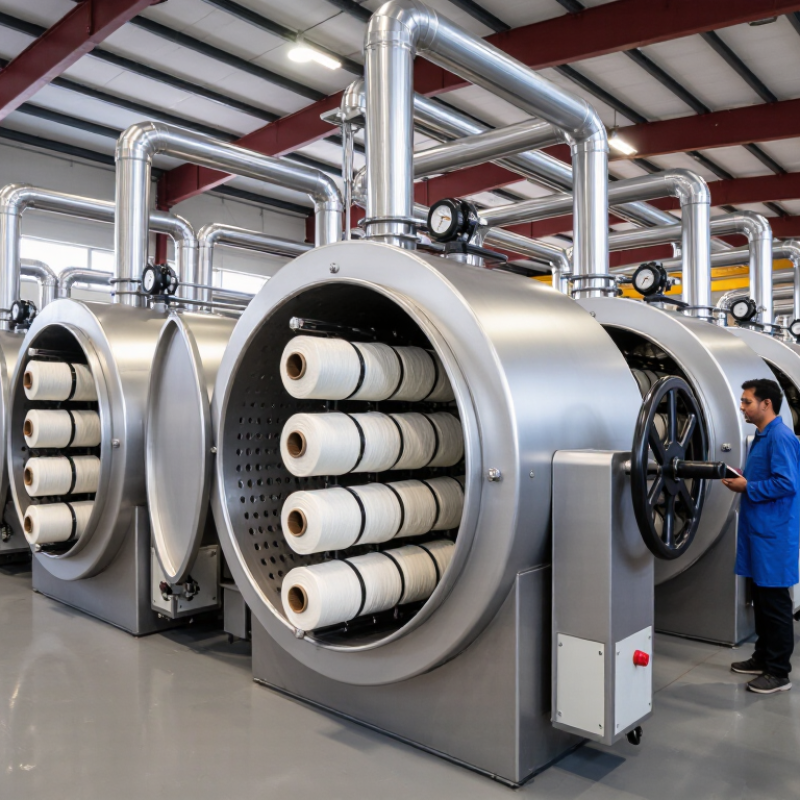
7 Best Package Dyeing Machines for Global Buyers?

What Is Package Dyeing and How Does the Process Work?

Package dyeing colors yarn after it has been wound onto perforated tubes, often called packages. The tubes sit on a spindle inside a closed dyeing vessel. Dye liquor circulates through the yarn, passing from the inside outward and then reversing direction. This movement helps distribute color through the package rather than only across its surface.

A typical process starts with loading and gently compacting the yarn packages. Operators check package density because tight winding can restrict liquor flow, while loose winding may cause uneven color. The vessel is filled with prepared liquor, then temperature and circulation are controlled according to the fiber and dye type. After dyeing, the yarn is rinsed, drained, and dried. Small details matter. A slight variation in winding can show up as pale patches later, so a test run is often worth the time. Even with careful settings, the first recipe may need adjustment.

Tips: Keep package density consistent and record the loading pattern, liquor ratio, temperature curve, and circulation settings for each batch. Check samples from different positions in the vessel, not just one package. If color appears uneven, review winding and flow conditions before changing the dye recipe; changing several variables at once makes troubleshooting harder.

Which Features Define a High-Quality Package Dyeing Machine?

A high-quality package dyeing machine keeps liquor moving evenly through every yarn package, from the outer layers to the core. Look for reversible circulation, stable pressure control, and independently monitored temperature. These features help reduce shade variation between packages. That matters. Ask for documented liquor ratio, energy use per kilogram, and repeatability results from production trials, not only laboratory samples. The European Commission’s Textile Industry BREF identifies water and energy consumption as important process-performance measures, so suppliers should provide figures with clear test conditions.

Package density control is just as important. Uneven winding can restrict flow, leaving pale cores or darker outer layers. Check that the machine supports consistent package preparation and adjustable flow for different yarn types. Recipe storage, alarms, accessible filters, and reliable seals make daily operation easier. The International Energy Agency’s report on electric motor-driven systems estimates that these systems use about 45% of global electricity; efficient pumps and well-matched motors therefore deserve close scrutiny. This is a broad industrial estimate, not a dye-machine benchmark. A polished specification sheet can still hide poor results. Request references, trial records, and maintenance intervals, then compare them with your own yarn and batch conditions.

7 Best Package Dyeing Machines for Global Buyers

For global buyers, the best package dyeing machine depends on yarn type, batch size, utilities, and local service access. Seven practical options to compare are high-temperature, high-pressure units; atmospheric-pressure machines; reversible-flow systems; multi-spindle vessels; single-spindle laboratory machines; modular production lines; and models with heat-recovery features. Each suits a different production profile. Small details matter.

High-temperature machines can handle many synthetic yarns, while atmospheric systems may suit heat-sensitive materials. Reversible liquor flow helps promote even dyeing through densely wound packages. Multi-spindle designs support larger batches, but require careful loading and consistent package density. Laboratory units are useful for recipe trials before scaling up. Modular lines offer flexibility as demand changes, though extra controls can mean more maintenance.

Before purchasing, check working capacity, pressure and temperature limits, pump performance, material compatibility, and control-system documentation. Ask for test results using yarn similar to yours, not just ideal sample conditions. Review water, steam, and power needs against the factory’s actual supply. A low liquor ratio on a brochure is not a guarantee; real loading can change it. Confirm spare-part availability, operator training, and service response in your region. The least expensive machine may become costly if downtime lasts weeks.

Typical dye-bath temperatures vary by fiber and dye recipe. Polyester commonly requires high-temperature, pressurized dyeing, while cotton, wool, and nylon are often processed at lower temperatures. Use these indicative values as a general comparison, not as machine operating limits.

How Do the Top Machines Compare in Capacity and Performance?

Capacity alone does not reveal how well a package dyeing machine performs. Buyers should compare its usable batch range, minimum loading, liquor ratio, cycle time, and temperature control. A 100-kilogram vessel may suit regular orders, yet run inefficiently when batches are much smaller. Check whether the machine handles the actual yarn package size and density. Small details matter: uneven winding can leave pale patches inside a package. Repeatability matters, too.

Textile Exchange’s Materials Market Report 2024 estimates that global fiber production reached 124 million tonnes in 2023, up from 116 million tonnes in 2022. That figure signals a large material base, but it does not measure dyehouse demand or machine output. Treat it as context, not a performance ranking.

When comparing seven machine types, request documented batch capacity, water and energy use per kilogram, and trial results on your own yarn. Ask for data at both full and partial loads. One catch: quoted cycle times may exclude loading, heating, rinsing, and unloading. Real throughput can be lower. Confirm the test conditions before comparing figures.

What Should Global Buyers Consider Before Purchasing a Machine?

Before purchasing a package dyeing machine, match its working range to the yarn and package types you actually process. Ask for trial data using comparable yarn counts, package densities, and dye recipes. A machine’s stated capacity may not reflect your daily mix. Check whether the spindle arrangement, package holders, and loading method suit your operators. Small details matter.

Review the circulation system, temperature control, pressure rating, and liquor ratio together. Uneven flow can leave pale or dark areas, even when the control panel shows stable settings. Ask how the machine monitors flow and temperature across the vessel, and request maintenance records or test results where available. Ask for evidence. Also confirm water, steam, power, and floor-space requirements before installation; a compact machine may still need substantial utility upgrades.

Consider cleaning access, spare-part availability, training, and the response time for technical support. Compare operating costs using realistic batch sizes, not only the supplier’s best-case figures. A visit to a working installation can reveal noise, loading effort, and cleaning time that a specification sheet misses. I would still leave room for doubt: one successful sample batch cannot prove performance across every shade and yarn. Include acceptance criteria in the purchase agreement, and clarify what happens if commissioning results fall short.

7 Best Package Dyeing Machines for Global Buyers? - What Should Global Buyers Consider Before Purchasing a Machine?

“Best” depends on the yarn, batch size, process conditions, and factory requirements. The configurations below are common machine options, not brand or model rankings.

Machine Configuration Typical Batch Capacity* Suitable Applications Key Advantages What Buyers Should Check
1. Laboratory Package Dyeing Machine Approximately 1–10 kg Recipe development, shade matching, small trials, and quality-control testing. Uses less yarn, water, and dye for trials; supports process development before production-scale dyeing. Confirm that package holders and liquor circulation represent the intended production process. Check temperature control, repeatability, and available sample-package formats.
2. Pilot-Scale Package Dyeing Machine Approximately 10–50 kg Scale-up trials, customer sampling, and small production runs. Bridges laboratory testing and factory production; can help identify differences in circulation and shade between scales. Ask how the pilot machine’s flow direction, package density, and liquor ratio compare with the planned production machine.
3. Atmospheric Package Dyeing Machine Commonly tens to several hundred kilograms, depending on design Suitable processes for cotton, viscose, wool, and other yarns dyed under atmospheric conditions. Designed for processes that do not require high-pressure operation; may be suitable for yarns and recipes processed at or below the boiling point of the dye bath. Verify the yarn’s permitted temperature and chemistry. Check corrosion-resistant wetted parts, heating method, circulation uniformity, and whether the selected process is compatible with atmospheric operation.
4. High-Temperature, High-Pressure (HTHP) Package Dyeing Machine Commonly tens to around 1,000 kg, depending on vessel size and configuration Often used for polyester and other synthetic yarn processes requiring temperatures above 100°C. A pressure-rated vessel enables high-temperature dyeing; many designs support controlled heating, cooling, and liquor circulation. Check the rated working temperature and pressure, applicable pressure-vessel certification, safety interlocks, inspection records, and suitability for the intended yarn and recipe. Polyester processes commonly use temperatures around 130°C, but the required conditions vary.
5. Low-Liquor-Ratio Package Dyeing Machine Available across sample and production scales Factories seeking to reduce dye-bath volume for compatible yarns, recipes, and loading conditions. Can reduce water, heating, and wastewater volumes when the process achieves the specified liquor ratio without compromising dyeing quality. Request the guaranteed liquor ratio at the proposed batch load. Check pump performance, package wetting, circulation uniformity, and actual water and energy data from comparable production trials.
6. Multi-Spindle Production Package Dyeing Machine Often several hundred kilograms or more; capacity depends on spindle count and yarn-package loading Regular, larger-scale yarn production with consistent package sizes and repeatable recipes. Processes multiple yarn packages in one batch and can provide high output when loading, circulation, and recipe control are well matched. Confirm the usable capacity for the actual yarn count and package dimensions—not just the vessel’s nominal capacity. Review spindle layout, pressure drop, flow distribution, loading time, and unloading access.
7. Automated, Recipe-Controlled Package Dyeing Machine Available from laboratory to production scale Plants that need repeatable recipes, batch records, and controlled process steps. Programmable control can manage process stages such as heating, holding, cooling, and dosing, subject to the machine’s installed equipment. Check recipe storage, sensor accuracy, dosing connections, alarm and safety functions, data export, operator training, and compatibility with the factory’s power supply and control systems.

Before purchasing: Match the machine to the yarn material, package dimensions, batch size, dyeing temperature, pressure requirements, and expected production schedule. Also compare installation requirements, utilities, water and energy consumption, safety documentation, local service availability, spare-parts lead times, and acceptance-test criteria. *Capacity figures are indicative only; actual usable capacity varies by machine design, yarn type, package size, and loading density.


Close

Raise your Query

Hi! Simply click below and type your query.

Our experts will reply you very soon.

WhatsApp Us
